
Cross Channel Management
Cross Channel Platform is CURABIS’s concept for unifying the web shop, stores, field sales reps, and future channels on a single shared data platform. Instead of point-to-point integrations, you get a single source of truth, real-time updates, and tight control from Business Central.

Integration with Business Central, without performance issues
Many integrations slow Business Central down. Cross Channel Platform consolidates data in one place and ensures controlled data exchange without putting load on the system. The solution is fully scalable and built on Azure with enterprise-level uptime (99.9%).
In the past, integrations could be built closer to the core. In classic Navision, you often worked with "shared tables" and solutions where the integration sat side by side with the system. That gave high performance and a more direct data model.
With the move to cloud and standardisation, the integration pattern changed. Web services became the natural choice. Not because it was optimal in every scenario, but because it was the available tool.
This means that today, data often has to be sent back and forth between systems. And as the volume grows, it affects both performance and complexity in Business Central.
The cloud places different demands on the architecture.
In the cloud environment, all solutions operate within fixed limits.
Business Central operates within fixed limits, where load is managed through throttling. This ensures stable operation across customers, but it becomes visible when many integrations and data calls run at the same time.
The consequence is less predictable performance.
Response times can vary, and processes become dependent on how much is happening in the system at the same time.
Why Cross Channel Platform
Cross Channel Platform replaces complex integrations with one unified architecture. Instead of tying systems together, you work directly on your data, across every channel.
With modern development and new tools, the challenge is no longer the development itself, but how solutions fit together. The platform makes sure you can develop and adapt without complexity growing.
One platform, controlled data flow
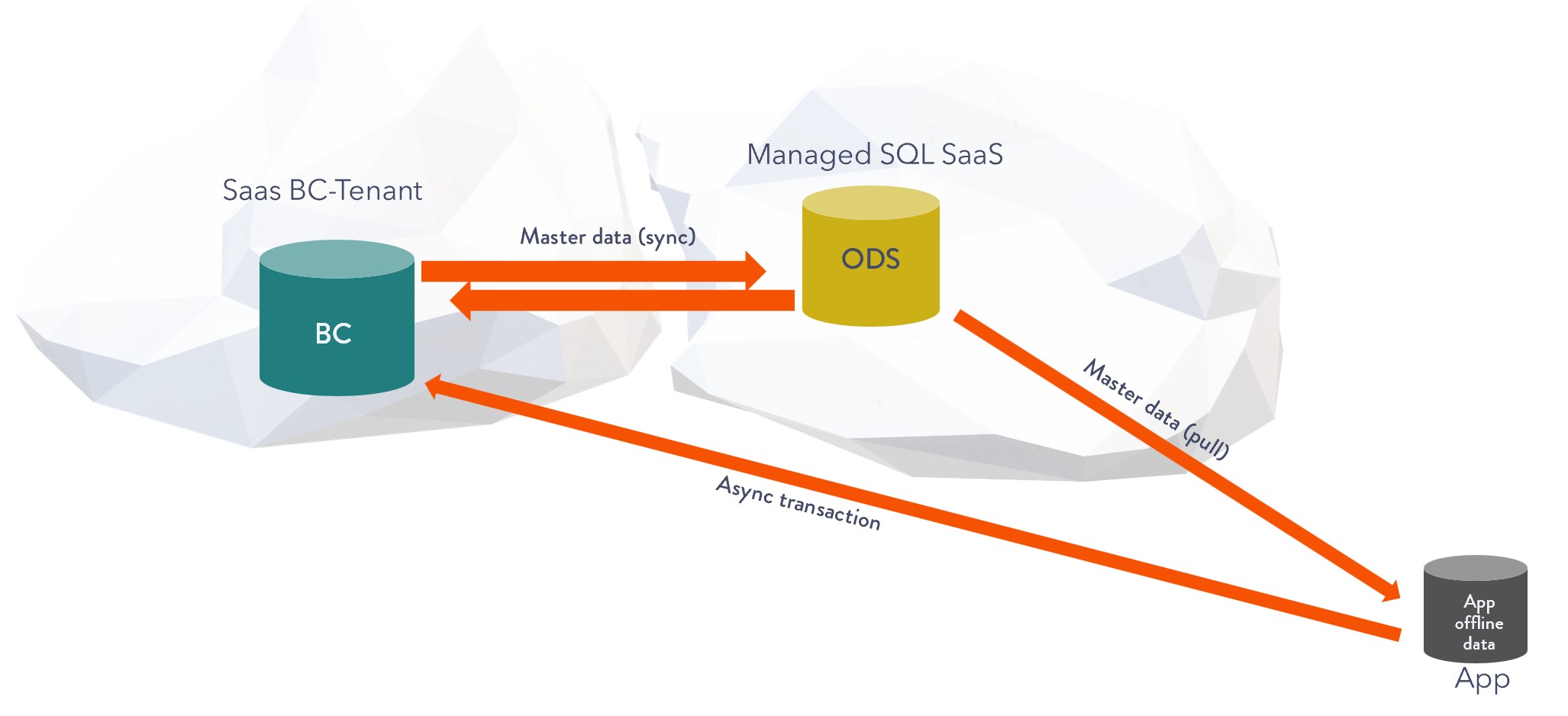
Flexible data exchange, without complexity
Data no longer flows through ad-hoc integrations.
With Cross Channel Platform, every solution works on mirrored data and exchanges information in a controlled way, synchronously or asynchronously, depending on the need.
This removes dependencies between systems and ensures that Business Central stays stable, no matter how many channels are connected.
What this means in practice:
A webshop can work directly on the platform's data and send orders asynchronously to Business Central.
This means a faster user experience, fewer errors and no direct load on Business Central during peak hours.
Examples of solutions built on the platform
Cross Channel Platform is the foundation, but the value comes from the solutions you build on top. Every channel works on the same data, without integrations between them, which reduces complexity and makes the solution easier to maintain. Below are examples of how the platform is used in practice.
Store / POS
The store solution is built offline-first in modern React with a local SQLite database. Sales can be completed without a connection and are synchronised automatically with the platform and Business Central.
You work on the same data as the webshop and ERP, with shared prices, inventory and customers.
You are not working with separate systems, but with one unified platform where every channel is connected from the start.
Get an assessment of your Business Central setup
We review your current setup and give concrete input on how you can simplify integrations and scale with Cross Channel Platform
What do you get out of the meeting?
A concrete assessment of your current setup
An overview of where complexity and bottlenecks emerge
Input on how you can work more scalably with your data
A realistic picture of the next step
We always start from your existing solution.
You meet an experienced systems architect who understands the complexity and who you can spar with. So you know where you stand, before you take the next decision.